Blog

If the New ACAS Code Lands, Accessibility Will Finally Become Everyone’s Business
Date: 4 August 2026
There’s been a lot of noise recently about the proposed ACAS Code of Practice. It’s not in force yet, but if it does come in, it quietly introduces something pretty significant — and honestly, long overdue.
One line in the draft jumps out: employers may need to provide documents “in a format that is accessible to the worker.” It’s a small sentence with a huge implication, because it recognises something many of us have been saying for years: digital documents aren’t just attachments or admin. They’re how work actually happens. They’re how people understand expectations, defend themselves, exercise their rights, and take part in the everyday rhythm of an organisation.
And if someone can’t access those documents? They’re effectively shut out of the process.
This is where people often ask, “Is this basically PSBAR for employers?” For anyone not familiar, PSBAR (Public Sector Bodies Accessibility Regulations 2018) is the law that requires public sector websites and digital services to meet accessibility standards. But what ACAS is proposing isn’t a mini‑PSBAR. It’s bigger. PSBAR is about websites. The ACAS Code is about employment. It’s about how organisations communicate with their own people, not their users.
If the Code comes into force, accessibility becomes part of what “acting reasonably” looks like in any workplace. Not just government departments. Not just councils. Every employer. Every sector. Every size.
And that matters, because inaccessible documents don’t just slow people down — they exclude them. They stop someone from preparing properly for a meeting. They make it harder to understand what’s being asked of them. They force people to rely on others. They create disadvantage before the conversation has even started.
The proposed Code nudges us towards a world where accessibility isn’t an add‑on or a specialist concern — it’s just part of how we work. Part of how we treat people fairly. Part of how we make sure everyone can participate independently.
If it comes into force, employers will need to adapt. But honestly? It’s the kind of change that makes workplaces clearer, kinder, and more respectful. And that’s something worth getting behind.
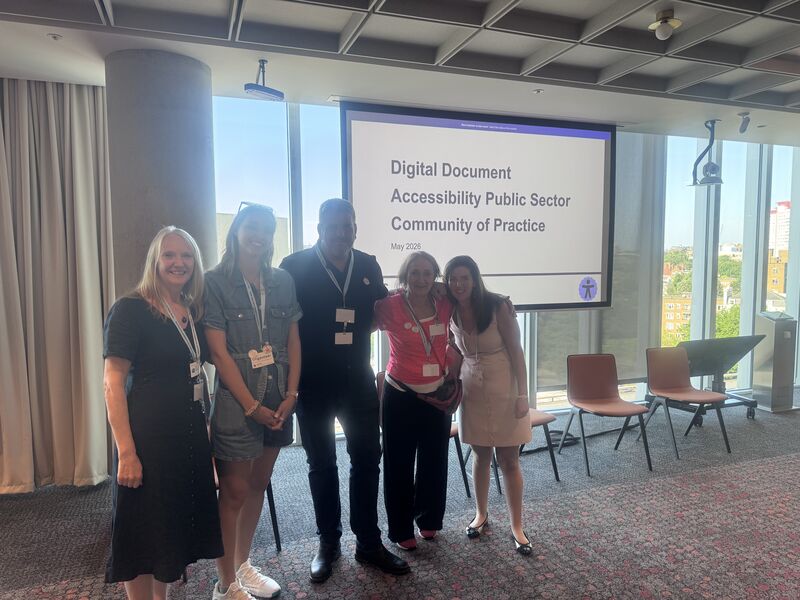
DAPS Conference at Microsoft Paddington
Date: 8 June 2026
Last week marked a genuinely proud moment—for me personally, and for our wider community.
We hosted the first Document Accessibility in the Public Sector (DAPS) Conference at Microsoft’s headquarters in Paddington. What began as a small collaboration in 2024 between Samantha Merrett (Ministry of Justice) and myself has grown into something far more impactful than either of us ever anticipated.
Today, the DAPS community includes over 403 members from more than 200 public sector organisations. This includes representatives from local and regional government, police forces, education, universities, training providers and central government departments. Bringing so many people together in one space felt like a significant milestone in our journey.
A huge thank you goes to our DWP partners at Microsoft, and especially to Connie Hornsby. Their support has been instrumental in helping us grow the community and bring this event to life.
Among the organisations represented on the day were HM Land Registry, North Ayrshire Council, Government Digital Service, Department for Energy Security and Net Zero (DESNZ), Care Quality Commission, Scottish Environment Protection Agency (SEPA), Nottinghamshire Fire and Rescue Service, Education Scotland, UK Anti-Doping, the Accessibility Testing Centre of Excellence, Department for Work and Pensions, Department for Education, Ministry of Justice, Public Health Wales, Medway Council, HMRC, the Health Research Authority, HM Inspectorate of Constabulary and Fire & Rescue Services, and many others.
Why this matters
Document accessibility is not simply about compliance—it’s about how we deliver services. Across the public sector, documents are often the service itself. Whether it’s a policy, a form, or guidance, inaccessible content creates real barriers for people who rely on it.
Our Leaders Panel
We were joined by senior leaders from across government and industry:
- Amanda Sleight – General Manager, Public Sector UK, Microsoft
- Sarah Homer – Director General People and Place, Department for Work and Pensions
- Alexander Chaplin – Service Modernisation Programme SRO, Department for Work and Pensions
- Shaun Conner – GOV.UK One Login Accessibility Lead, Government Digital Service
- Paul Bepey – Digital Accessibility Manager, PwC UK
- Paul Haigh – Chief Technology Officer, Ministry of Justice
- Hosted by Charlie Turrell – Accessibility Champions Manager and Engagement Lead, Ministry of Justice
What stood out most was the alignment across the panel. This was not a discussion focused solely on compliance or standards. Instead, it highlighted how accessibility connects directly to service delivery, organisational culture, and leadership accountability.
Key themes
- Accessibility must be owned at a senior level—it cannot sit solely with specialists.
- It needs to be embedded into everyday processes, not added retrospectively.
- It should be viewed as an opportunity to improve services for everyone.
Leaders spoke honestly about challenges, shared what is working, and emphasised the importance of continued collaboration across departments.
Community reflections
Feedback from attendees reinforced important messages:
- Accessibility is everyone’s responsibility.
- Small design decisions can have a significant impact.
- Accessible documents benefit all users.
What the feedback told us
The response to the event was overwhelmingly positive. Attendees described the conference as accessible, relevant, and valuable. Many left feeling inspired and equipped with practical ideas.
“Brilliant. Uplifting and well organised.”
“So inspiring – I left with lots of ideas.”
A big shift
One of the clearest takeaways is that accessibility must be designed in from the start—embedded into the way we create, review, and deliver content.
If you’re interested in continuing the conversation and contributing to this growing cross‑government community: Join the DAPS LinkedIn group.